Homoeopathy, as founded by Samuel Hahnemann, is often described as a dynamic system of medicine that primarily focuses on the totality of symptoms and the individualistic expression of disease. However, the role of pathology in homoeopathic practice is both significant and indispensable. A true homoeopathic physician must skillfully integrate pathological understanding with symptomatology to ensure accurate assessment, prognosis, and ultimately, cure.
Homoeopathy and Pathology: The Relationship
In Organon of Medicine, Hahnemann emphasizes that disease is not merely a structural alteration but a dynamic disturbance of the vital force. Yet, he never dismisses the importance of pathological changes. Instead, pathology serves as a confirmatory and evaluative tool.
Pathology helps the physician to:
- Understand the extent and depth of disease
- Identify tissue-level changes
- Assess the reversibility or irreversibility of the condition
- Formulate a prognosis
Thus, while the remedy is selected based on symptoms, pathology provides the clinical background and boundaries within which the remedy acts.
Why Pathological Assessment is Essential
Modern homoeopathic practice cannot function in isolation from pathology. Clinical experience shows that symptomatic relief does not always equate to cure. A patient may feel better, but underlying pathology may persist.
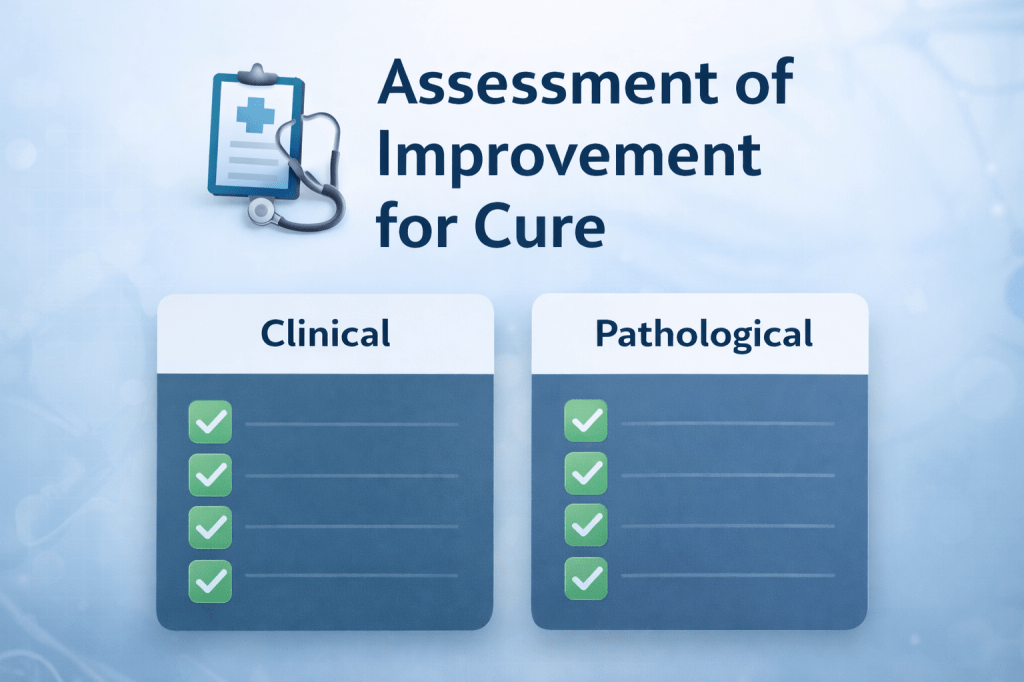
This is where a structured assessment—like dividing improvement into Clinical and Pathological—becomes crucial.
- Clinical Improvement
Relief in symptoms (pain, itching, breathlessness, etc.)
Improved appetite, sleep, and energy
Better mental and emotional state - Pathological Improvement
Reduction in inflammation or lesion size
Normalization of lab parameters
Radiological evidence of healing
Hahnemann cautions against declaring cure prematurely.
According to the principles of the Organon, a case can only be considered cured when both subjective (clinical) and objective (pathological) improvements align.
Importance of the Clinical–Pathological Checklist
A homoeopathic physician must adopt a dual-check system:
✔️ Clinical – What the patient feels
✔️ Pathological – What the body shows
This checklist ensures:
- Avoidance of false cure (symptoms gone, disease persists)
- Prevention of suppression
- Accurate follow-up and remedy repetition
- Scientific validation of homoeopathic results
For example, in chronic diseases like arthritis, asthma, or PCOS, symptomatic relief alone is insufficient. Without pathological improvement (like reduced inflammation markers or normalized imaging), the disease may still progress silently.
Homoeopathy as an Integrative Science
Homoeopathy does not stand against pathology—it completes it. Pathology explains the “what” of disease, while homoeopathy addresses the “why” and “how” at a dynamic level.
A physician grounded in both:
- Uses pathology for diagnosis and monitoring
- Uses homoeopathy for individualized healing
This integration elevates homoeopathy from a symptomatic art to a complete scientific healing system.
Conclusion
The relationship between homoeopathy and pathology is not contradictory but complementary. As guided in the Organon, the physician’s highest aim is to cure—rapidly, gently, and permanently. This can only be achieved when improvement is assessed both clinically and pathologically.
A simple checklist of Clinical and Pathological improvement is not just a tool—it is a responsibility. It ensures that the cure is not superficial but deep, not temporary but lasting.In modern practice, a homoeopath who understands pathology is not deviating from Hahnemann—rather, they are fulfilling his vision in a more complete and scientific manner.
DR. JAGRUTI SINGH
MD (Hom.), BHMS
Vadodara, Gujarat, INDIA
 Pure Care with Homeopathy