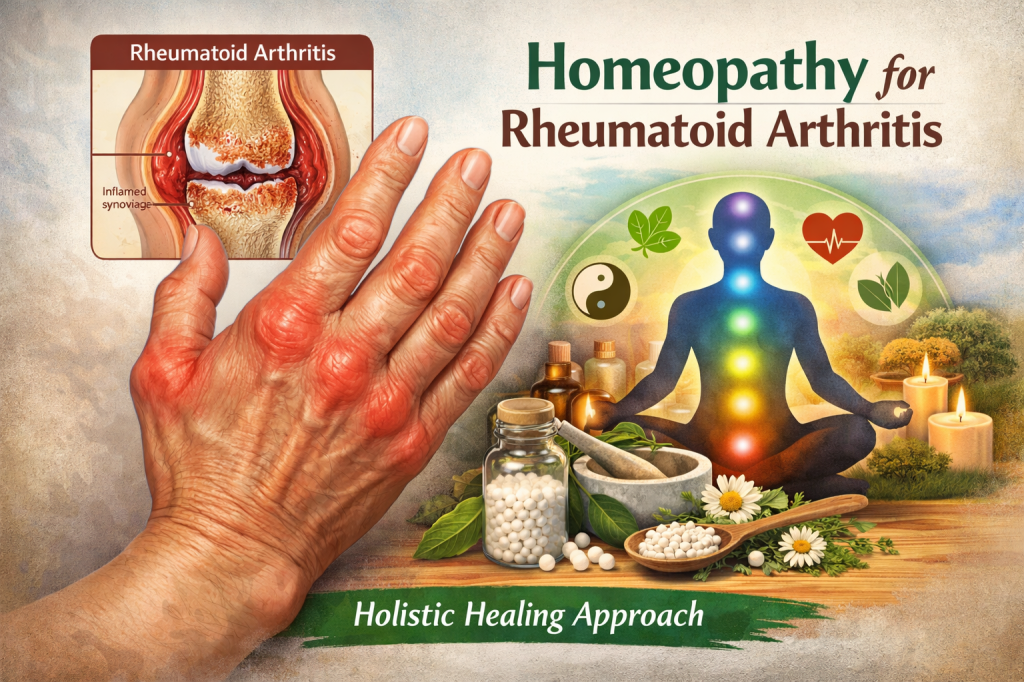
Rheumatoid Arthritis (RA) is a chronic autoimmune disorder characterized by persistent inflammation of synovial joints, progressive joint destruction, pain, stiffness, and functional disability.
From a pathological perspective as a Assistant Professor of Pathology,RA involves autoimmune-mediated synovial inflammation leading to pannus formation, cartilage erosion, and bone damage. While conventional medicine focuses on immunosuppression and symptomatic relief, homoeopathy approaches the disease from a deeper, individualized perspective—aiming to stimulate the body’s inherent healing mechanisms.
As emphasized by Organon of Medicine, the fundamental principle of homoeopathy is “Similia Similibus Curentur” (like cures like). According to Hahnemann, disease is not merely a structural pathology but a disturbance of the vital force, which manifests through symptoms at physical, mental, and emotional levels. In autoimmune diseases like RA, this disturbed vital force leads the body to mistakenly attack its own tissues. Homoeopathic treatment aims to correct this imbalance rather than merely suppress the inflammatory response.
From a pathological standpoint, RA involves autoimmune activation with inflammatory cytokines, synovial proliferation, and immune complex deposition in joints. However, homoeopathy does not prescribe solely based on the pathological diagnosis.
Instead, the totality of symptoms—including modalities, constitution, mental state, and individual susceptibility—is considered. This individualized prescription is one of the strengths of homoeopathic therapeutics in chronic autoimmune conditions.
Several homoeopathic remedies have demonstrated clinical usefulness in cases presenting with rheumatoid pathology. For example:
Rhus Toxicodendron is often indicated in patients with stiffness aggravated by rest and relieved by motion, with joint pain worse in damp weather.
Bryonia Alba may be useful when pain worsens with the slightest movement and improves with rest, accompanied by swelling and dryness of mucous membranes.
Causticum can be considered in cases with chronic joint deformities and progressive stiffness.
Pulsatilla may benefit patients with migratory joint pains and symptoms that change frequently, especially in gentle, emotionally sensitive individuals.
In clinical practice, a homoeopathic physician evaluates the miasmatic background of the patient as well. Chronic autoimmune conditions like RA often show a complex interplay of psoric, sycotic, and syphilitic miasms, which influence disease progression and remedy selection.
Addressing the underlying miasmatic tendency can help reduce recurrence, slow joint damage, and improve overall vitality.
Research and clinical observations suggest that homoeopathy may help in reducing pain, stiffness, swelling, and improving joint mobility in RA patients when treatment is individualized.
Moreover, homoeopathic medicines are administered in highly potentized doses, which are gentle, non-toxic, and generally free from adverse effects when prescribed correctly.
It is important to understand that homoeopathy does not aim for quick symptomatic suppression but for long-term regulation of immune imbalance.
With proper case-taking, constitutional prescribing, and regular follow-up, many patients experience improvement not only in joint symptoms but also in energy levels, sleep, emotional well-being, and general health.
In conclusion, homoeopathy offers a holistic and individualized therapeutic approach in the management of Rheumatoid Arthritis. By integrating principles from the Organon, understanding pathological processes, and applying constitutional remedies, a qualified homoeopathic practitioner can help support the body’s healing response and improve the quality of life of individuals suffering from this chronic autoimmune disease.
for consultation
call us on 63511 17175
address : FF 38,FORTUNE GATEWAY, CHHANI JAKATNAKA, VADODARA
DR. JAGRUTI SINGH
MD(Hom.),BHMS
 Pure Care with Homeopathy